Formal Verification
How BLVM checks consensus against the Orange Paper: spec-lock methodology, coverage, CI gates, and tooling. For what blvm-consensus implements and how it relates to the spec, see Consensus Overview.
BLVM Specification Lock binds #[spec_locked] Rust functions to Orange Paper contracts and discharges obligations with Z3. Empirical layers (testing, differential testing, fuzz, MIRI) stress the same surface from complementary angles. Together: Rust + Tests + Math Specs = Source of Truth.
Inventory and verification policy: consensus verification guide, spec-lock coverage inventory, and proof limitations.
What formal verification delivers
readable math IR] ANN["#[spec_locked]
contracts on code"] Z3[Z3 discharge] DRIFT[Spec drift check] CI[CI merge gate] OP --> ANN ANN --> Z3 OP --> DRIFT Z3 --> CI DRIFT --> CI
A human-auditable source of meaning. Consensus rules live in the Orange Paper first. Reviewers, including mathematicians who never read the node, can argue about subsidy, PoW, and script semantics in the same language the proofs use.
Proofs locked to the functions they protect. Annotation with #[spec_locked] attaches Orange Paper contracts to concrete Rust. Change the code, and the obligations travel with it: proofs are not a detached appendix that drifts from the implementation.
Machine-checked alignment on merge. Z3 verifies those contracts on every change. CI runs check-drift then verify on self-hosted runners, so a PR that softens a rule or breaks a proven invariant fails the gate instead of shipping as “still green on unit tests.”
Growing, measurable coverage. Spec-lock covers 251 #[spec_locked] functions across the stack (240 in blvm-consensus, 5 in blvm-node, 6 in blvm-protocol) and ~433 parseable obligations (reconfirm with cargo spec-lock coverage).
Confidence to evolve. Proven bounds feed optimization passes. Refactors and performance work land against the same contracts. Future implementations can share the Orange Paper as common IR; each codebase earns trust by locking to that IR, not by copying another node’s source.
A full assurance stack. Specification Lock answers: does this function still mean what the Orange Paper says? Property tests, fuzzing, MIRI, and differential testing against Bitcoin Core answer complementary questions about edge cases, undefined behavior, and historical mainnet agreement. Each layer strengthens the others; none is ornamental.
Consensus verification operates on public block data. Secret-path constant-time cryptography (signing, ECDH, MuSig secrets) lives in blvm-secp256k1, a deliberate split so conformance proofs and timing discipline each have the right home.
Verification Stack
Layer 1: Empirical Testing
- Unit tests: Broad coverage across consensus modules and public APIs
- Property-based tests: Randomized testing with
proptestto discover edge cases - Integration tests: Cross-system validation between consensus components
Layer 2: Symbolic Verification
- BLVM Specification Lock: Z3-backed proofs on spec-locked functions
- Mathematical specifications: in-book digest and Orange Paper contracts
- State space exploration: Paths relevant to spec-lock contracts
Layer 3: CI Enforcement
- Automated testing: Required for merge
- BLVM Specification Lock: Required on merge; see verification policy
- OpenTimestamps audit logging: Optional timestamps of verification artifacts
Verify JSON semantics (blvm-spec-lock)
cargo spec-lock verify emits structured status per function. Failed means the proof obligation did not pass: CI gates on these when strict mode is enabled. Partial marks obligations demoted or skipped (timeout, translation gap, advisory tier): read the log and verify JSON format for jq filters; treat Passed under explicit policy as the release signal.
Verification Statistics
Formal Proofs
BLVM Specification Lock runs a single verify pass over all spec-locked functions and merged F_* formula registry rows.
Coverage snapshot (count #[spec_locked] in source; re-run cargo spec-lock coverage for contract totals):
| Crate | Spec-locked functions |
|---|---|
| blvm-consensus | 240 |
| blvm-node | 5 |
| blvm-protocol | 6 |
| Total | 251 |
Parseable obligations: ~433 (reconfirm with cargo spec-lock coverage --spec-path …).
Verification Command (clone blvm-spec next to the crate so ../blvm-spec exists, or set SPEC_LOCK_SPEC_PATH):
# Install CLI (matches library floor; picks latest published 0.1.x)
cargo install blvm-spec-lock --version '>=0.1, <1' --locked --features z3

export SPEC_LOCK_STRICT=1
export SPEC_LOCK_Z3_TIMEOUT_SECS=120   # overrides --timeout when set

cargo spec-lock check-drift \
  --crate-path . \
  --spec-path ../blvm-spec/PROTOCOL.md ../blvm-spec/ARCHITECTURE.md \
  --scoped-unparseables

cargo spec-lock verify \
  --crate-path . \
  --spec-path ../blvm-spec/PROTOCOL.md ../blvm-spec/ARCHITECTURE.md \
  --timeout 120 \
  --format human \
  --json-out spec_lock_verify.json
Common filters (same verify subcommand):
cargo spec-lock verify --name get_block_subsidy --crate-path . --spec-path ../blvm-spec/PROTOCOL.md
cargo spec-lock verify --section 6.1 --crate-path . --spec-path ../blvm-spec/PROTOCOL.md
cargo spec-lock verify --subsystem economic --crate-path . --spec-path ../blvm-spec/PROTOCOL.md
There is no --tier flag. CI runs one full verify pass on self-hosted runners ([self-hosted, Linux, X64, builds]): check-drift (with --scoped-unparseables, and --scoped-formulas when the installed CLI supports it), then verify with --json-out. See the consensus CI workflow and spec-lock dependency guide.
Proof rigor (policy classification, not separate runner pools): verification-tiers.toml groups functions by expected proof depth:
- Tier 1: Full Z3 body proof required (subsidy, PoW, reorg primitives)
- Tier 2: Invariant + proptest coverage for complex bodies
- Tier 3: Differential equivalence harnesses (crypto backends, FFI boundaries)
Local development uses the same verify command as CI. For property tests, fuzz, MIRI, and the full test matrix, see Testing Infrastructure.
CI Integration
The Verify / verify jobs in blvm-consensus, blvm-node, and blvm-protocol CI are the authoritative cargo-spec-lock gates. Optional umbrella workflow_dispatch mirrors exist for multi-repo workspace checkouts.
- Unit & Property Tests (required in each crate CI):
cargo test --all-features - BLVM Specification Lock (required where
#[spec_locked]is enabled):check-driftthenverifyper the spec-lock dependency guide - OpenTimestamps Audit (non-blocking: consensus umbrella CI parity / monorepo only where enabled)
Run commands locally: Testing Infrastructure. Other subcommands: coverage, summary, list, check-formulas, verify-formulas. Full CLI reference: blvm-spec-lock.
Network Protocol Verification
blvm-protocol uses the same BLVM Specification Lock machinery for wire messages: headers, checksums, size limits, and round-trip properties for the message types in scope.
Proof targets: Header layout (magic, command, length, checksum), checksum validation, size limits, parse(serialize(msg)) == msg for covered messages.
Wire message groups (verification scope): Group A: Version, VerAck, Ping, Pong. Group B: Transaction, Block, Headers, Inv, GetData, GetHeaders. (This grouping is for protocol verification only, not governance tiers.)
Use the verify feature for full protocol verification builds; see protocol overview.
Consensus Coverage Comparison
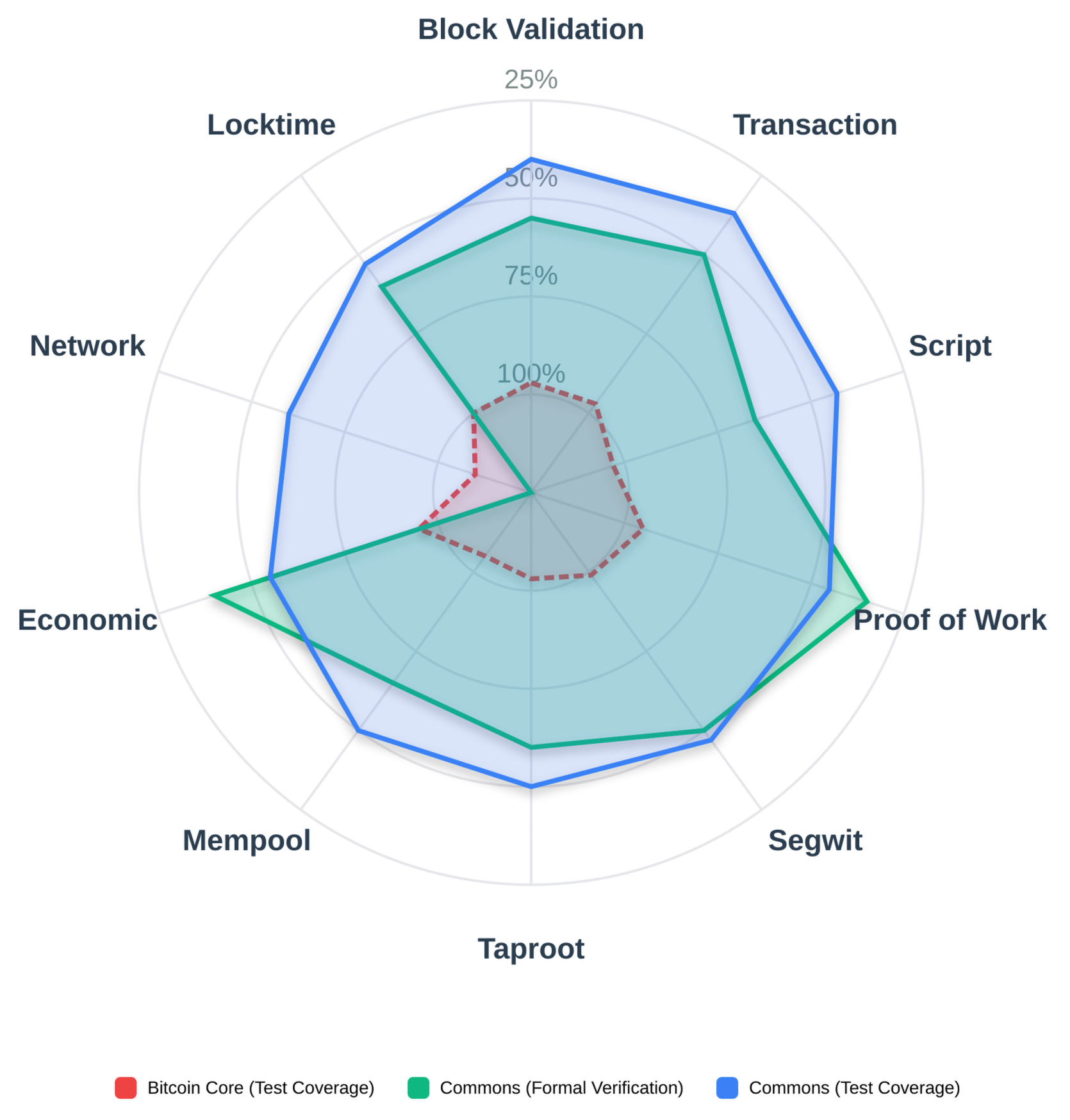 Figure: Baseline: broad tests and review. Bitcoin Commons adds BLVM Specification Lock and Orange Paper-driven methodology on top.
Proof Maintenance Cost
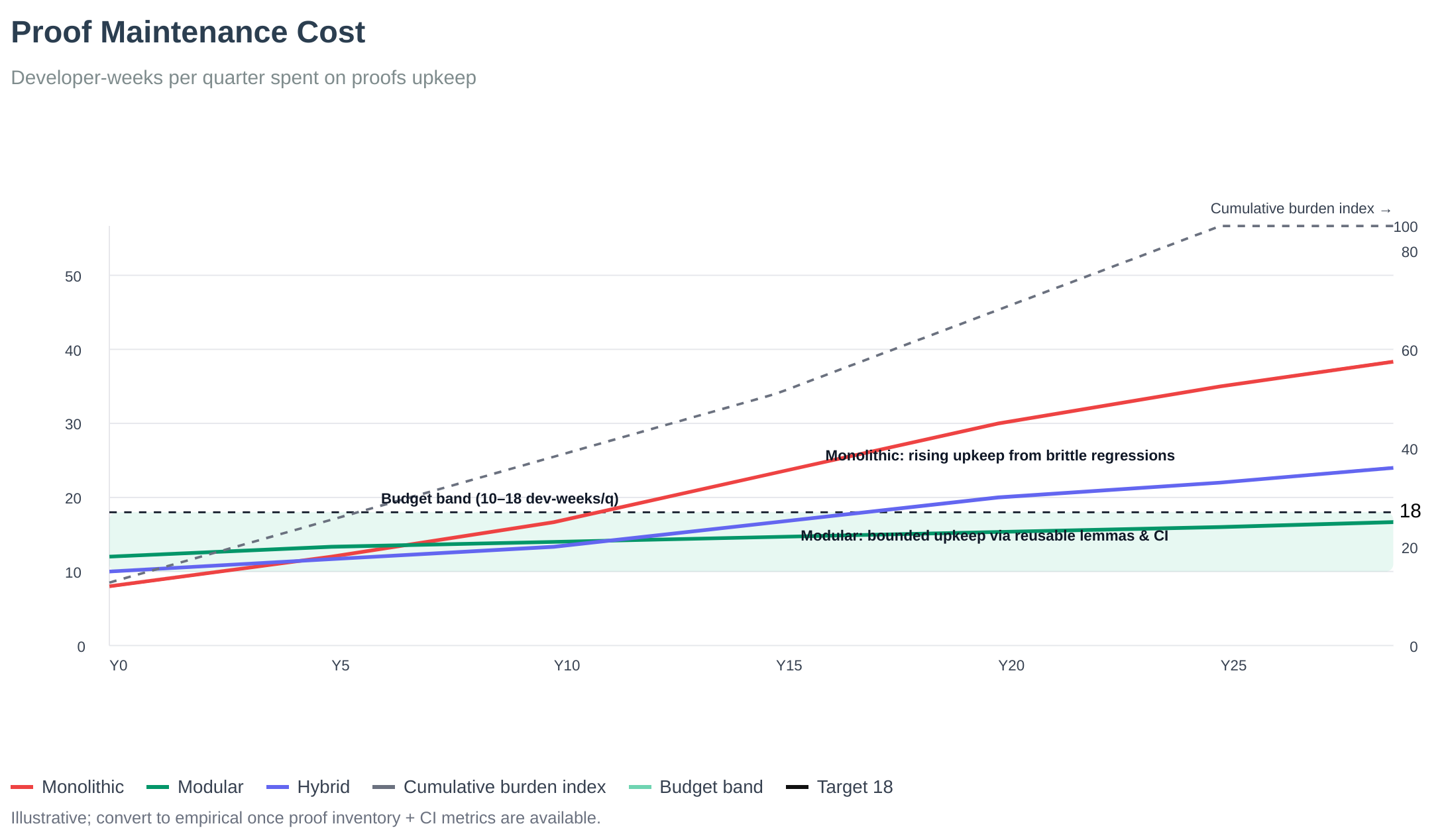 Figure: Proof maintenance cost: proofs changed per change by area; highlights refactor hotspots.
Spec Drift vs Test Coverage
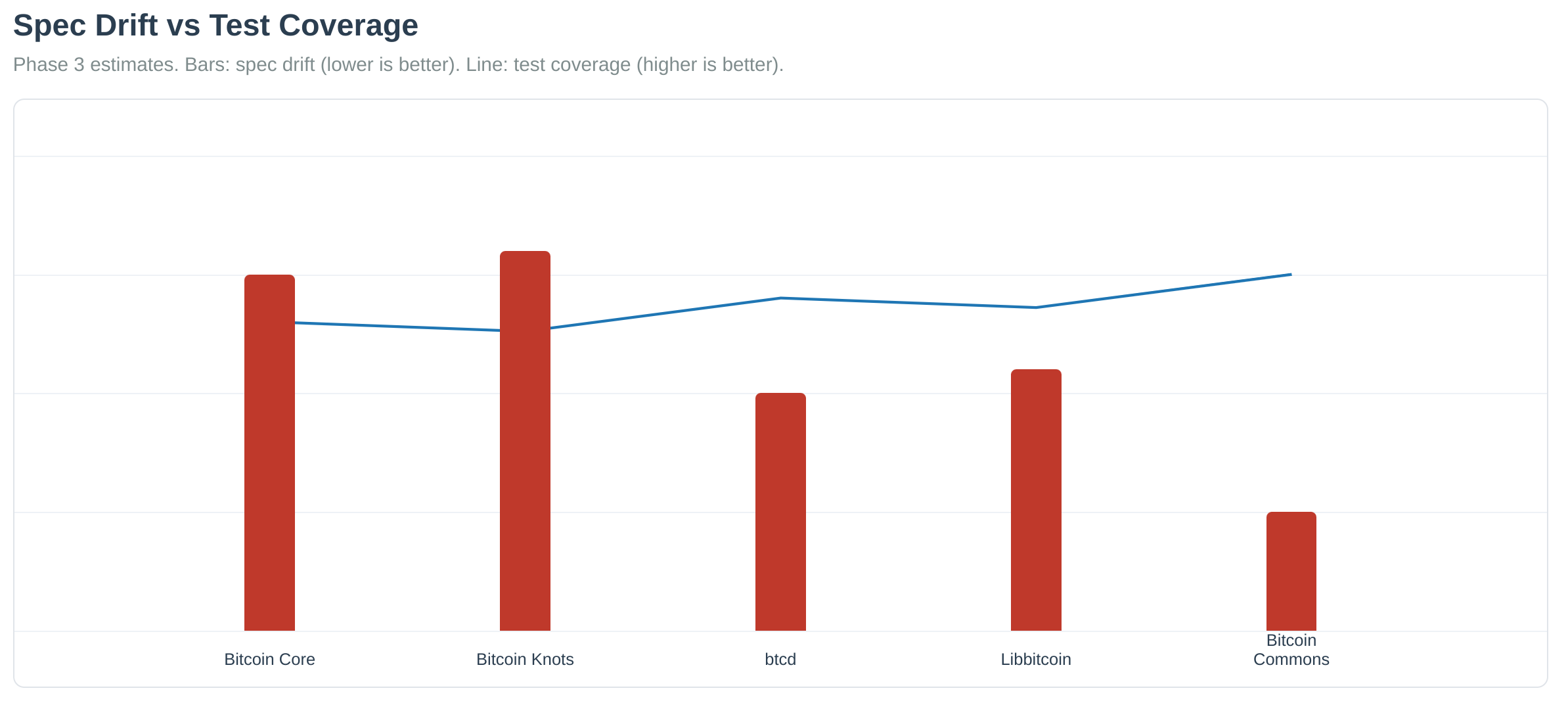 Figure: Spec drift decreases as test coverage increases. Higher test coverage reduces the likelihood of specification drift over time.
See also Network Protocol for transport and wire-format documentation.
Policy and inventory: verification policy and proof limitations. Formal properties per rule: Mathematical Specifications.
Source
- Consensus CI workflow (Verify job; MIRI when nightly is available)
See Also
- Consensus Overview: What the consensus layer implements
- Mathematical Specifications: Mathematical spec details
- Property-Based Testing: Property-based testing
- Differential Testing: BLVM vs Bitcoin Core
- Fuzzing: Fuzzing infrastructure
- Testing Infrastructure: Complete testing overview