Consensus Layer Overview
blvm-consensus answers one question: given a transaction, block, UTXO set, and activation flags, does Bitcoin consensus accept it? It does not open sockets, read blvm.toml, or choose mainnet vs regtest. That belongs to blvm-protocol and blvm-node.
What this layer is for
Consensus code is the trust anchor of the stack. Wallets, pools, and modules depend on the node reporting chain state that matches what every other Bitcoin mainnet participant would accept. If validation is wrong here, every higher layer is wrong.
The layer implements rules from the Orange Paper as deterministic Rust: script execution, block connection, subsidy and difficulty math, mempool acceptance rules used by the node, and soft-fork behavior at documented activation heights. Block and script logic live in block/ and script/ submodules; canonical types, serialization, and crypto come from blvm-primitives (re-exported by blvm-consensus for API stability).
Relationship to the Orange Paper
The Orange Paper is the specification (implementation-agnostic IR). blvm-consensus is the implementation, validated against that spec, not generated from it. Optimization passes speed the code without changing specified meaning; see Optimization passes.
Chain of trust: Orange Paper → blvm-consensus → tests + spec-lock → node deployment
Verification methodology, coverage, and CI: Formal Verification. Policy: verification policy, proof limitations.
What lives here vs elsewhere
| Concern | Layer |
|---|---|
| Script/block/UTXO math | blvm-consensus (this page) |
| Network magic, ports, message serialization | blvm-protocol |
| Storage, P2P, RPC, modules | blvm-node |
| Fast sync (UTXO commitments, peer consensus, spam filtering) | node docs (blvm-protocol / blvm-node, not consensus rules) |
| Orange Paper function catalog & Rust API names | API Index: Consensus |
Architecture position
Stack layer 2: between the Orange Paper (layer 1) and protocol abstraction (layer 3). Full stack: Stack overview.
Design principles
- Pure functions: Deterministic validation; explicit inputs instead of hidden globals
- No rule interpretation in apps: Node calls into consensus; modules never patch rules
- Controlled dependencies:
Cargo.tomlpins and ranges are the source of truth for crypto and BLVM crates - Testing in depth: Testing, property-based tests, differential testing via blvm-bench
- Formal verification: Spec-lock proofs complement tests; see Formal Verification
- No consensus rule interpretation: Only mathematical implementation of the Orange Paper
- Optimization passes: Runtime optimizations speed the code without changing specified meaning; see Optimization passes
Core functions
Transaction validation
- Transaction structure and limit validation
- Input validation against UTXO set
- Script execution and verification
Block validation
- Block connection and validation
- Transaction application to UTXO set
- Proof of work verification
Economic model
- Block reward calculation
- Total supply computation
- Difficulty adjustment
Mempool protocol
- Transaction mempool validation
- Standard transaction checks
- Transaction replacement (RBF) logic
Mining protocol
- Block creation from mempool
- Block mining and nonce finding
- Block template generation
Chain management
- Reorganization primitives in blvm-consensus (
src/reorganization.rs); blvm-node wires them for the liveprocess_blockpath (block index, chainwork tip selection, undo persistence, events: see blvm-node fork choice and reorg) - P2P network message processing
Advanced features
- SegWit: Witness data validation and weight calculation (see BIP141)
- Taproot: P2TR output validation and key aggregation (see BIP341)
Optimization passes
The implementation is validated against the Orange Paper; optimization passes optimize the implementation code (not the spec). Meaning is defined by the Orange Paper; see compiler-like architecture. Production and Rayon feature flags: consensus features.
- Constant folding: Pre-computed constants and constant propagation
- Memory layout optimization: Cache-aligned structures and compact stack frames
- SIMD vectorization: Batch hash operations with parallel processing
- Bounds check optimization: Removes redundant runtime bounds checks using BLVM Specification Lock-proven bounds
- Dead code elimination: Removes unused code paths
- Inlining hints: Aggressive inlining of hot functions
Spec maintenance workflow
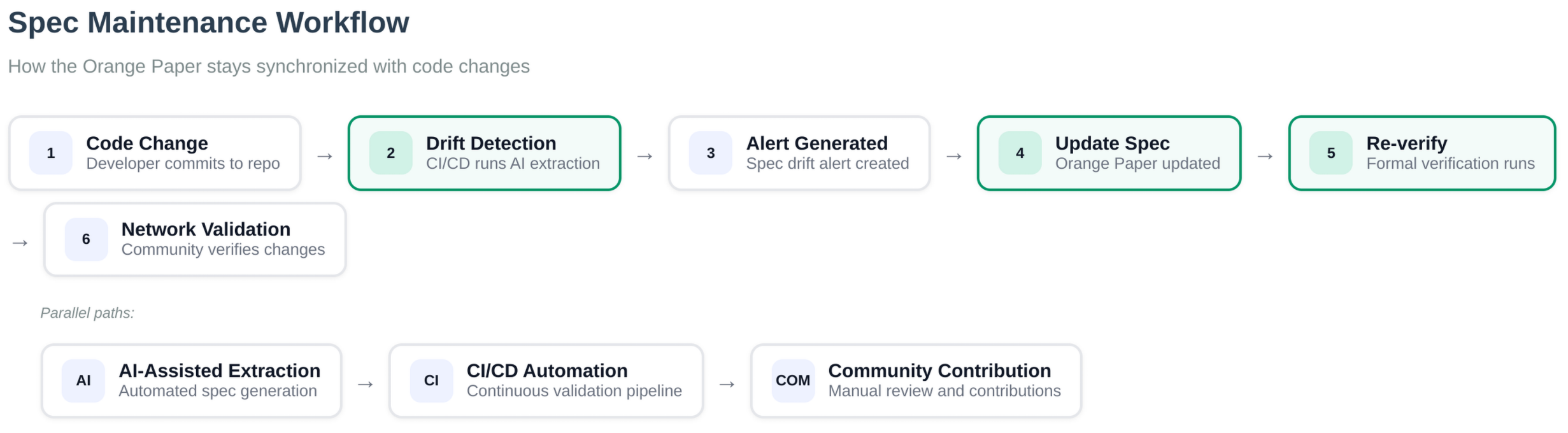 Figure: Specification maintenance workflow showing how changes are detected, verified, and integrated.
BIP implementation
Consensus integrates consensus-critical BIPs in validation paths, for example BIP30/34/66/90/147 in block connection and script verification. Activation heights and network variants are coordinated with blvm-protocol network parameters.
Performance
Consensus hot paths support PGO builds (./scripts/pgo-build.sh in blvm-consensus), batch script verification, and optimization passes. Optimize after correctness gates; measure on your workload.
Mathematical protection mechanisms and formal properties are documented in Mathematical Specifications.
Dependencies
Declare versions from blvm-consensus Cargo.toml. blvm-primitives supplies shared types; consensus re-exports many for API stability.
Source code
| Area | Repository path |
|---|---|
| Crate root | blvm-consensus |
| Transactions / scripts | src/transaction.rs, src/script/ |
| Blocks / chain | src/block/ |
| Economic rules | src/economic.rs |
| Mempool rules | src/mempool.rs |
| Mining helpers | src/mining.rs |
| SegWit / Taproot | src/segwit.rs |
| Optimizations | src/optimizations.rs |
See Also
- API Index: Consensus functions
- Formal Verification: Methodology
- Mathematical Specifications: Formal properties
- Orange Paper: Normative spec