Governance Model
Bitcoin Commons implements a constitutional governance model that makes Bitcoin governance 6x harder to capture.
BTCDecoded Governance Process
⚠️ ACTIVATION STATUS
Current Status: Phase 1 (Infrastructure Building)
- ✅ Infrastructure Complete: All core components implemented
- ⚠️ Not Yet Activated: Governance rules are not enforced
- 🔧 Test Keys Only: No real cryptographic enforcement
- 📋 Development Phase: System is in rapid AI-assisted development
Timeline:
- Phase 2 Activation: 3-6 months (governance enforcement begins)
- Phase 3 Full Operation: 12+ months (mature, stable system)
Constitutional Governance Model
Bitcoin Commons implements a 5-tier constitutional governance system that makes Bitcoin governance 6x harder to capture than Bitcoin Core's current model, with complete transparency through cryptographic audit trails and user-protective mechanisms.
Core Innovation: Apply the same cryptographic enforcement to governance that Bitcoin applies to consensus - making power visible, capture expensive, and exit cheap.
How Governance Works
Action Tiers (Constitutional Model)
Tier 1: Routine Maintenance (3-of-5, 7 days)
- Bug fixes, documentation, performance optimizations
- Non-consensus changes only
Tier 2: Feature Changes (4-of-5, 30 days)
- New RPC methods, P2P changes, wallet features
- Must include technical specification
Tier 3: Consensus-Adjacent (5-of-5, 90 days)
- Changes affecting consensus validation code
- Consensus impact analysis and security audit expectations
Tier 4: Emergency Actions (4-of-5, 0 days review period)
- Critical security patches, network-threatening bugs
- Maintainer coordination, post-mortem required
Tier 5: Governance Changes (Special process, 180 days)
- Changes to governance rules themselves
- Extended public comment and maintainer unanimity per policy
Pull Request Process
- Developer opens PR
- Code:
blvm-commons/src/webhooks/pull_request.rs:handle_pull_request()
- Code:
- Governance App classifies tier automatically (with temp. manual override)
- Code:
blvm-commons/src/validation/tier_classification.rs:classify_tier()
- Code:
- Maintainers review and sign:
/governance-sign <signature>- Code:
blvm-commons/src/webhooks/comment.rs:handle_governance_sign()
- Code:
- Review period elapses (tier-specific duration)
- Code:
blvm-commons/src/validation/review_period.rs:check_review_period()
- Code:
- Requirements met → merge enabled
- Code:
blvm-commons/src/enforcement/merge_block.rs:should_block_merge()
- Code:
- PR merged
See HOW_TO.md for detailed step-by-step instructions.
Signature Requirements by Layer
- Layer 1-2 (Constitutional): 6-of-7 maintainers, 180 days (365 for consensus changes)
- Layer 3 (Implementation): 4-of-5 maintainers, 90 days
- Layer 4 (Application): 3-of-5 maintainers, 60 days
- Layer 5 (Extension): 2-of-3 maintainers, 14 days
Note: When both Layer and Tier requirements apply, the system uses the "most restrictive wins" rule. See LAYER_TIER_MODEL.md for detailed combination rules.
Layer + Tier Combination
The governance system combines two dimensions:
- Layers (Repository Architecture) - Which repository the change affects
- Tiers (Action Classification) - What type of change is being made
When both apply, the system takes the most restrictive (highest) requirements:
| Example | Layer | Tier | Final Signatures | Final Review | Source |
|---|---|---|---|---|---|
| Bug fix in blvm-protocol | 3 | 1 | 4-of-5 | 90 days | Layer 3 |
| New feature in blvm-sdk | 5 | 2 | 4-of-5 | 30 days | Tier 2 |
| Consensus change in blvm-spec | 1 | 3 | 6-of-7 | 180 days | Layer 1 |
| Emergency fix in blvm-node | 4 | 4 | 4-of-5 | 0 days | Tier 4 |
See LAYER_TIER_MODEL.md for the complete decision matrix.
Emergency Tier System
Bitcoin Commons uses a three-tiered emergency response system for proportional handling of critical issues.
Tier 1: Critical Emergency (Network-Threatening)
Activation Criteria:
- Inflation bugs (CVE-2010-5139 class)
- Consensus fork risks (CVE-2018-17144 class)
- P2P network DoS vulnerabilities
- Remote code execution
- Private key extraction
Requirements:
- 0 day review period
- 4-of-7 maintainer signatures
- 5-of-7 emergency keyholders to activate
- 7 day maximum duration
- No extensions allowed
Post-Activation:
- Post-mortem required within 30 days
- Security audit required within 60 days
- Public disclosure after patch deployment
Historical Examples:
- CVE-2010-5139 (2010): Value overflow allowing creation of 184B BTC. Fixed in 5 hours with hard fork.
- CVE-2018-17144 (2018): Inflation bug allowing double-spend of same input. Same-day patch, coordinated disclosure.
Rationale: Some vulnerabilities threaten network survival and require immediate action. Historical incidents show response times measured in hours, not days or weeks. Tier 1 enables this while maintaining multi-signature security (4-of-7).
Tier 2: Urgent Security Issue
Activation Criteria:
- Memory corruption vulnerabilities
- Privacy leaks (transaction linkage)
- Crash exploits (non-DoS)
- Privilege escalation
- Data corruption bugs
Requirements:
- 7 day review period
- 5-of-7 maintainer signatures
- 5-of-7 emergency keyholders to activate
- 30 day maximum duration
- One extension allowed (30 days, requires 6-of-7)
Post-Activation:
- Post-mortem required within 60 days
- Public disclosure after majority node deployment
Historical Examples:
- BIP66 Consensus Fork (2015): Non-upgraded miners accepted invalid block. Required urgent but not immediate coordination over hours/days.
Tier 3: Elevated Priority
Activation Criteria:
- Competitive response (other implementations advancing)
- Important bug fixes (non-security)
- Performance degradation issues
- Ecosystem compatibility problems
- User experience issues affecting adoption
Requirements:
- 30 day review period
- 6-of-7 maintainer signatures
- 5-of-7 emergency keyholders to activate
- 90 day maximum duration
- Two extensions allowed (30 days each, requires 6-of-7)
Post-Activation:
- Post-mortem required within 90 days
- Immediate public disclosure
Emergency Activation Process
- Emergency keyholder submits activation request with evidence
- Other emergency keyholders review and sign (5-of-7 required)
- Governance App activates tier and adjusts requirements
- Status checks reflect emergency parameters
- PRs merged under emergency rules
- Post-activation requirements tracked
- Automatic expiration at max duration unless extended
Safeguards
Abuse Prevention:
- All emergency activations logged in governance repository
- Post-mortem required for accountability
- Tier downgrades if criteria not met
- Community oversight via public disclosure
Automatic Expiration:
- No indefinite emergency modes
- Extensions require higher thresholds (6-of-7 vs 5-of-7)
- Multiple extensions discouraged
Escalation Path:
- Start with appropriate tier based on evidence
- Can escalate if situation worsens
- Cannot downgrade active emergency without resolution
See emergency-tiers.yml for complete configuration.
Consensus Rule Changes
Important: BTCDecoded governance is advisory only for Bitcoin protocol consensus changes. Maintainers cannot force network adoption.
Scope Clarification
What We Control (Repository Governance):
- Merge access to BTCDecoded repositories
- Maintainer selection and removal
- Official release creation
- Code quality standards
What We Don't Control (Protocol Governance):
- Bitcoin network consensus rules
- User adoption decisions
- Node operator choices
- Miner signaling
Consensus Change Process
When changes affect consensus rules (consensus-rules/**, validation/**, block-acceptance/**):
Repository Requirements (Binding):
- 6-of-7 maintainer signatures
- 365 day review period
- BIP specification required
- Comprehensive test vectors required
- Security audit required
- Equivalence proof required (mathematical correctness)
User Activation (Advisory Only):
- Code Approved: Maintainers approve with 6-of-7 signatures
- Code Released: Published as optional upgrade
- Users Signal: Node operators choose whether to upgrade
- Activation Decision: Based on network signaling thresholds
Recommended Thresholds (Advisory):
- 75% node adoption
- 90% hash power signaling
- Economic majority (e.g., 5 of top 10 exchanges)
Measurement:
- BIP9-style version bits or node polling
- 90-day measurement period
Clarification: Maintainers approve code for release. Users decide whether to run it. No amount of maintainer signatures forces network adoption. Users retain sovereignty to fork, run alternatives, or reject changes.
See SCOPE.md for detailed explanation of repository vs. protocol governance.
Formal Verification Requirements
Technical Prerequisites for Consensus Changes
BTCDecoded implements mathematical verification of consensus code to prevent capture and ensure correctness. This creates an objective, non-negotiable technical barrier that complements social governance.
Verification Stack
-
blvm-spec-lock Formal Verification (required)
- Z3-based verification of
#[spec_locked]functions - Proves mathematical invariants against Orange Paper specifications
- Cannot be bypassed or overridden
- Z3-based verification of
-
Property-Based Testing (required)
- Randomized testing with
proptest - Discovers edge cases through fuzzing
- Complements spec-lock with empirical coverage
- Randomized testing with
-
Mathematical Specifications (required)
- Formal documentation of consensus rules
- Invariants documented in code
- Traceability to Orange Paper
Enforcement Levels
Level 1: CI Enforcement (Ostrom #4: Monitoring)
- Automated verification runs on every PR
- Blocks merge if verification fails
- No human override possible
- Technical correctness is non-negotiable
Level 2: Governance App (Ostrom #5: Graduated Sanctions)
- Validates verification passed before allowing signatures
- PRs without passing verification cannot progress
- Prevents maintainers from signing unverified code
Level 3: Meta-Governance (Ostrom #3: Collective Choice)
- Verification requirements set by maintainers collectively
- Changes require 5-of-7 signatures + 90-day review
- Community can propose improvements
Defense Against Capture
Formal verification makes Bitcoin governance 6x harder to capture:
- Technical Barrier: Must bypass automated verification
- Social Barrier: Must convince 6-of-7 maintainers
- Time Barrier: 180-365 day review periods
- Transparency Barrier: All verification results public
- Audit Barrier: OpenTimestamps immutable proof
- Community Barrier: Public review and transparent process
Key Insight: An attacker cannot simply "convince maintainers" - they must also produce mathematically correct code that passes verification. This dramatically raises the bar for malicious changes.
Verification Status
Current verification coverage: [Link to docs/VERIFICATION.md]
See Cross-Layer Dependencies for separation rules.
Meta-Governance
Changes to governance rules themselves require:
- 5-of-7 maintainers + 2-of-3 emergency keyholders
- 90-day review period
- 30-day public comment period
- Rationale document required
Maintainer Lifecycle
Adding Maintainers:
- Nominated by existing maintainer
- 5-of-7 approval from current maintainers
- 30-day community comment period
- Must demonstrate technical competence and alignment with Bitcoin principles
Contributor Progression: See CONTRIBUTOR_GUIDE.md for possible paths from contributor to maintainer. These are documented options, not rigid requirements. Merit-based selection emerges naturally through contributions.
Removing Maintainers:
- 6-of-7 vote (excluding subject maintainer)
- Formal warning logged in
warnings/directory - 14-day notice period
- Reasons: inactivity (6+ months), code of conduct violations on-platform only (off-platform activity disregarded), competence concerns
Rotation:
- Maintainers may voluntarily step down with 30-day notice
- Encouraged rotation every 3-5 years to prevent centralization
- Emeritus status available for advisory role
Ostrom Principles Compliance
BTCDecoded governance follows Elinor Ostrom's principles for managing common-pool resources:
- Clearly Defined Boundaries: Maintainer roles and repository scope defined
- Proportional Equivalence: Higher-layer (constitutional) changes require more consensus
- Collective Choice: Maintainers participate in rule-making that affects them
- Monitoring: Governance App enforces rules transparently on GitHub
- Graduated Sanctions: Warning system before maintainer removal
- Conflict Resolution: Meta-governance process for disputes
- Minimal Recognition of Rights: GitHub org recognizes this governance structure
- Nested Enterprises: Layered architecture with appropriate rules per layer
Note: We govern the codebase commons (repository access), not the network commons (Bitcoin protocol). Users govern the network through voluntary adoption.
Governance Signature Thresholds
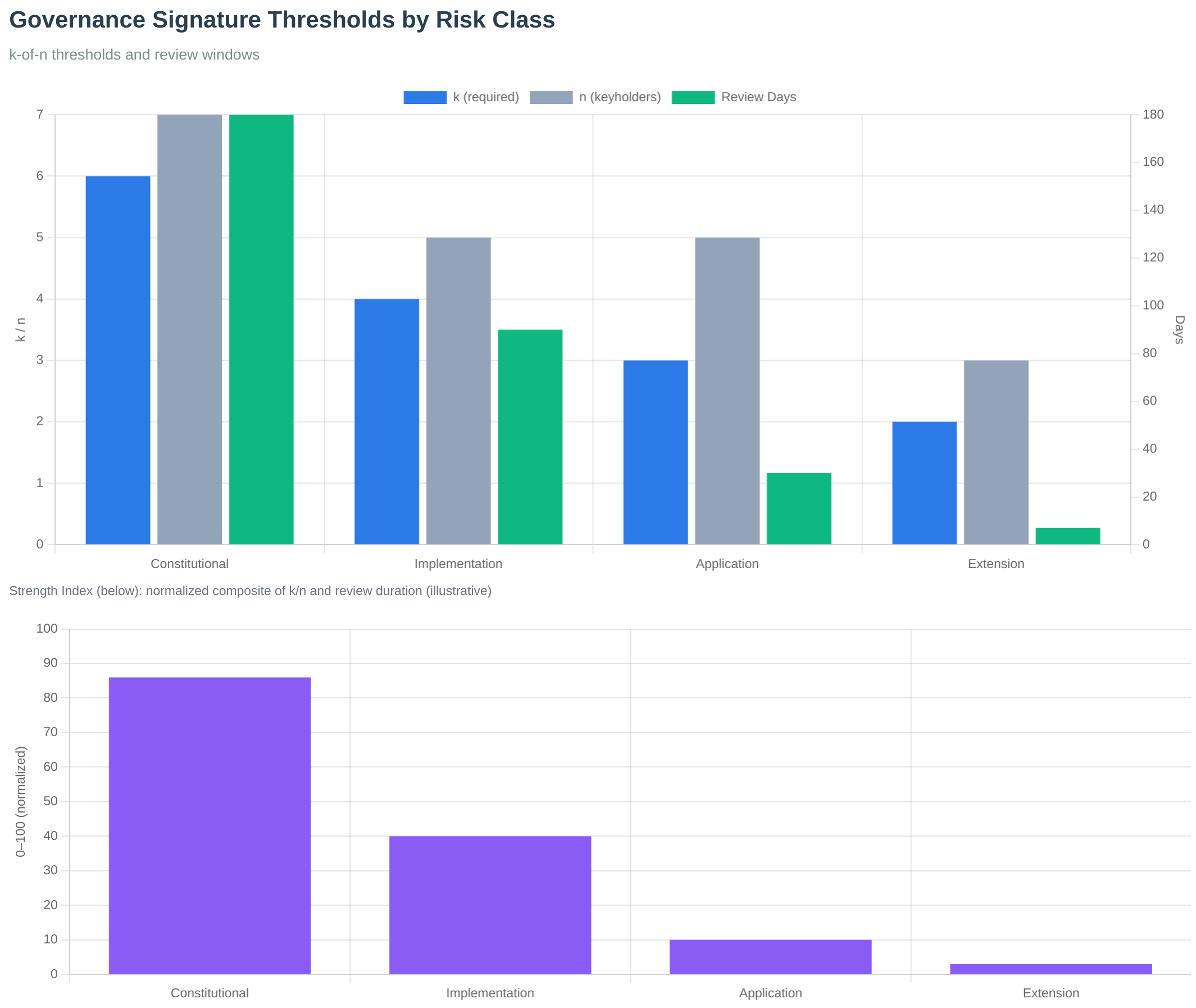 Figure: Signature thresholds by layer showing the graduated security model. Constitutional layers require 6-of-7, while extension layers require 2-of-3.
Governance Process Latency
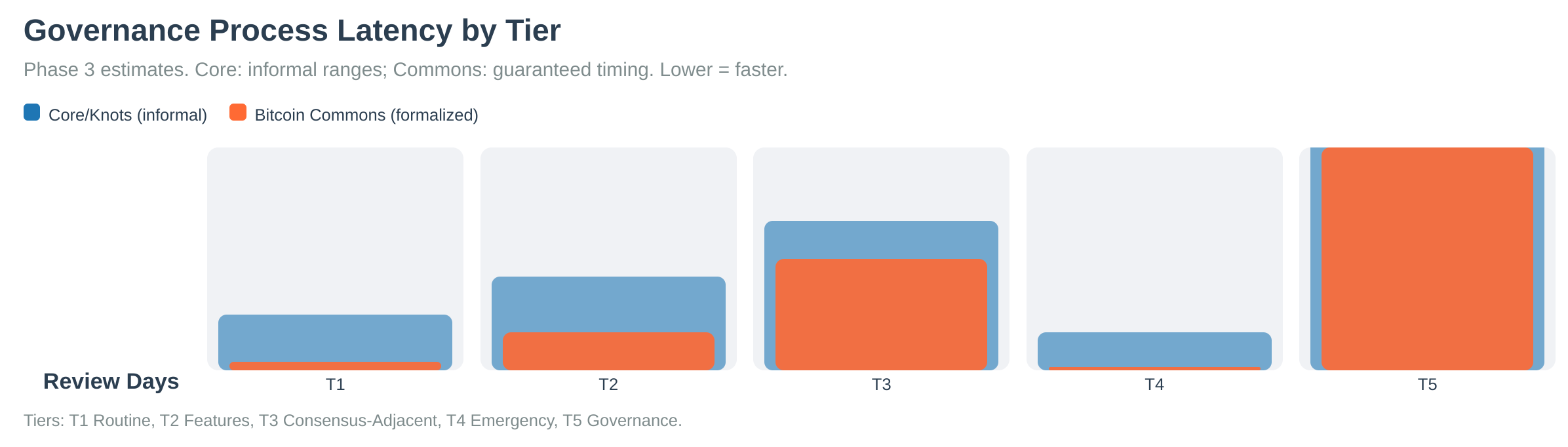 Figure: Governance process latency showing review periods and decision timelines across different tiers.
PR Review Time Distribution
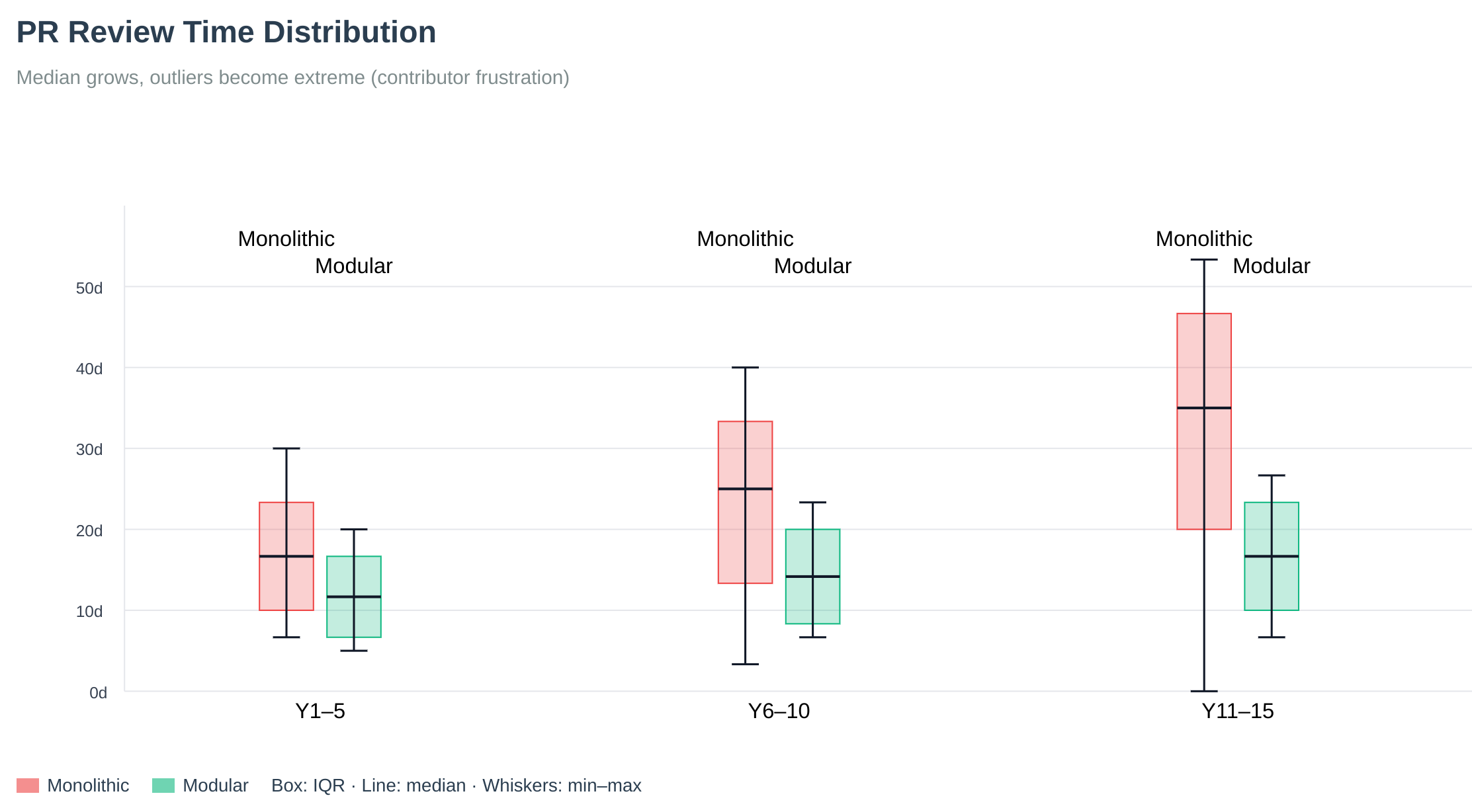 Figure: Pull request review time distribution. Long tails reveal why throughput stalls without process and tooling. Bitcoin Commons addresses this through structured review periods and automated tooling.
See Also
Operator quick answers (FAQ)
- Do I need governance to run a node?
- What is Bitcoin Commons vs BLVM?
- What are layers, tiers, and signatures?
- Why “6x harder to capture”?
- Is the system production ready? (governance is not universally activated)
Governance docs
- PR Process - How governance applies to pull requests
- Layer-Tier Model - Layer and tier combination rules
- Multisig Configuration - Signature threshold configuration
- Governance Overview - Governance system introduction
- Keyholder Procedures - Maintainer responsibilities